 New Naqqali
The Royal Genealogies
Twenty-six plates set out every line of descent the poem names, from Kioumars to the last Yazdegard: the Pishdadian and Kayanian kings, the houses of Turan, the Pahlevans of Nimruz and the thirty-one reigns of the house of Sasan.
Every name is spelled as it stands in the translation, and every figure is keyed to the chapter in which the poem gives the relation. Ferdowsi records what he records: where the poem leaves a person unnamed, the plates say so rather than supply a name from elsewhere, and where descent runs through generations the poem does not enumerate, a broken line stands in their place.
Tap any plate to open it; use the arrows to move from plate to plate.
How to read the plates
- A shaded box, name in small capitals
- a reigning Shah of Iran; on a woman’s name, a queen who reigns in her own right
- A broken box, name in small capitals
- a ruler of Turan or another king outside the line of Iran, or a usurper of its throne
- A plain box
- a prince, champion or noble who does not reign
- An unboxed name
- a figure named only in passing
- Italic
- a woman
- A double rule between two names
- a marriage
- A broken line
- descent through generations the poem does not name
- A dotted line
- a relation of another kind, noted on the plate
- Small grey type
- the chapter where the relation is given
Volume IBooks A0 to B14
Eight plates set out every line of descent named in Books A0 to B14 — the Pishdadian kings from Kioumars to Fereydoon, the three houses into which Fereydoon divided the world, the Kayanian succession down to Kay Khosrow, and the great families of Iran and Turan whose quarrels carry the narrative. Every name is spelled as it stands in this volume, and every figure is keyed to the chapter in which the poem first gives the relation.
Ferdowsi records what he records. Where the poem leaves a person unnamed — the daughter of Iraj, the mother of Siavash, the daughter of Tus — the plates say so rather than supply a name from elsewhere. Where the descent runs through generations the poem does not enumerate, a broken line stands in their place.
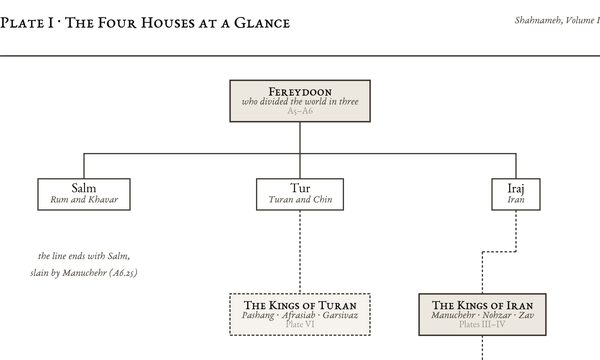 Plate IThe Four Houses at a GlanceShahnameh, Volume I
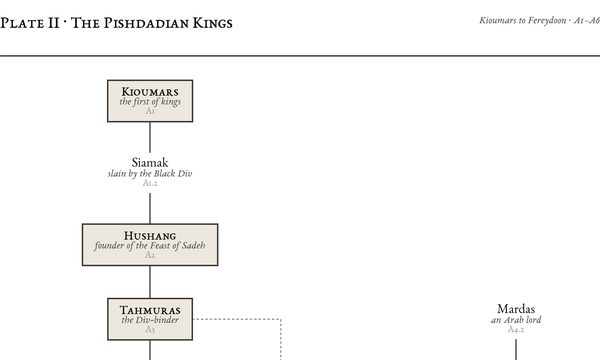 Plate IIThe Pishdadian KingsKioumars to Fereydoon · A1–A6
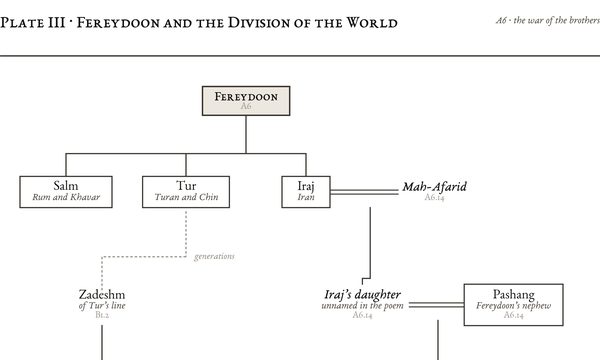 Plate IIIFereydoon and the Division of the WorldA6 · the war of the brothers
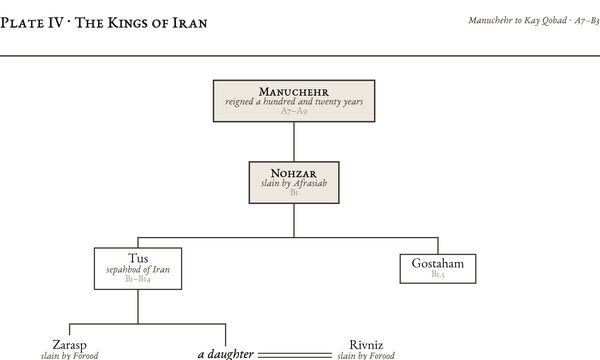 Plate IVThe Kings of IranManuchehr to Kay Qobad · A7–B3
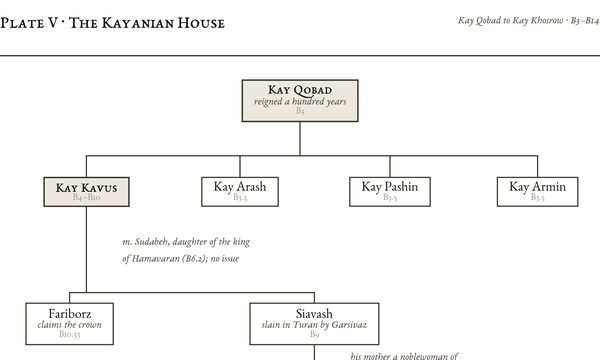 Plate VThe Kayanian HouseKay Qobad to Kay Khosrow · B3–B14
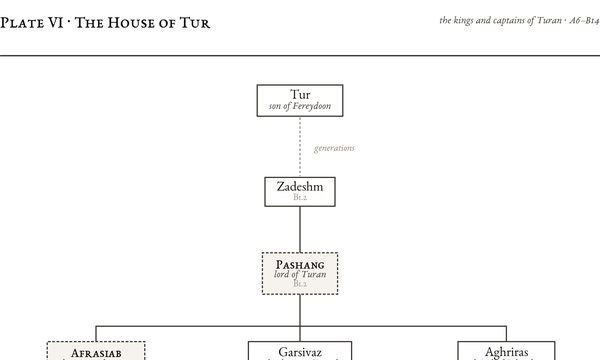 Plate VIThe House of Turthe kings and captains of Turan · A6–B14
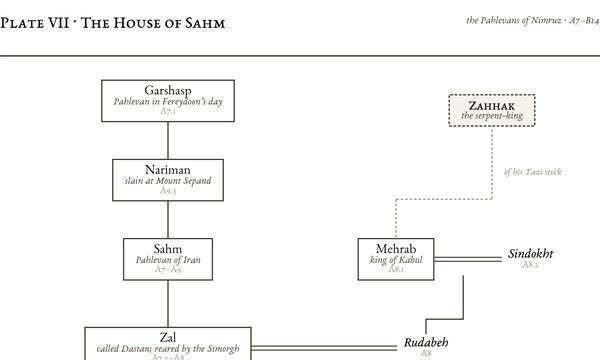 Plate VIIThe House of Sahmthe Pahlevans of Nimruz · A7–B14
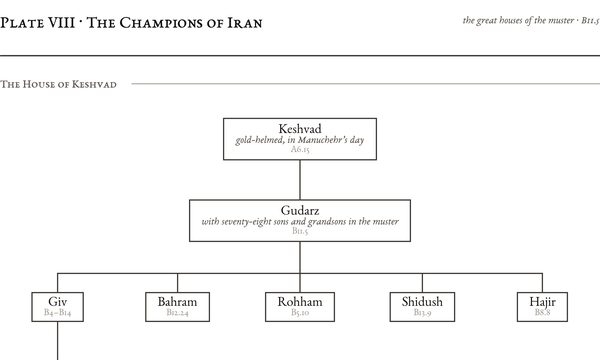 Plate VIIIThe Champions of Iranthe great houses of the muster · B11.5
Volume IIBooks C1 to D5
Nine plates set out every line of descent named in Books C1 to D5. This is the volume in which the old houses end. Afrasiab and Garsivaz are beheaded, Piran and every son of Viseh fall at the Battle of the Rukhs, Kay Khosrow gives the crown away and vanishes, Rostam dies in a pit at Kabul and his line is broken, and Arjasp’s house is destroyed. What follows is a new descent — Lohrasp of Hushang’s line, Goshtasb, Esfandiyar, Bahman — running down to Dara and to Iskandar, whom the poem makes Dara’s own half-brother.
Every name is spelled as it stands in this volume, and every figure is keyed to the chapter in which the poem gives the relation. Where the poem leaves a person unnamed — Darab’s second bride, the daughter of Kabul’s king who weds Shaghad — the plates say so rather than supply a name from elsewhere. Figures carried over from Volume I for the sake of a descent are marked as such.
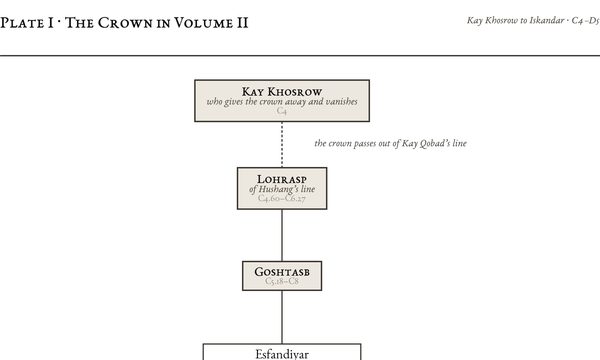 Plate IThe Crown in Volume IIKay Khosrow to Iskandar · C4–D5
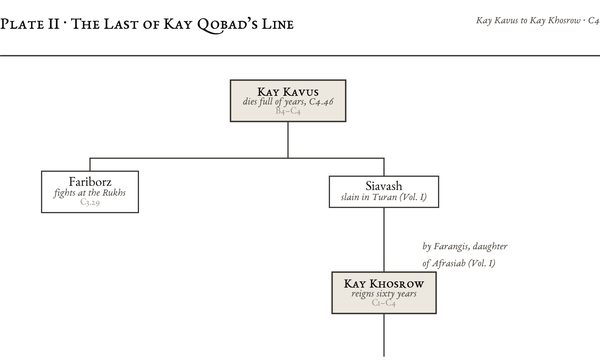 Plate IIThe Last of Kay Qobad’s LineKay Kavus to Kay Khosrow · C4
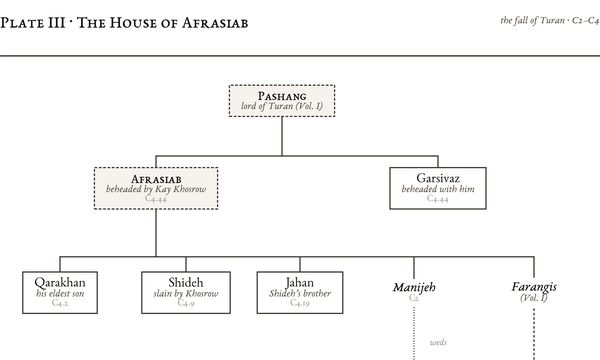 Plate IIIThe House of Afrasiabthe fall of Turan · C2–C4
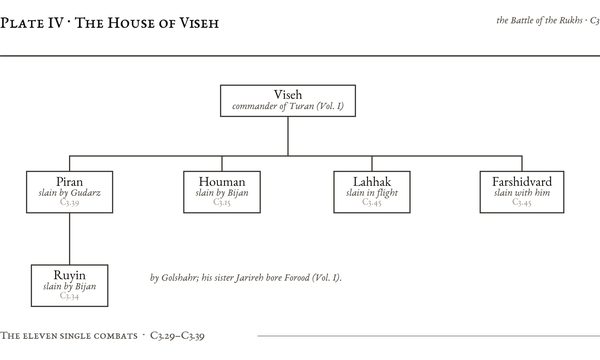 Plate IVThe House of Visehthe Battle of the Rukhs · C3
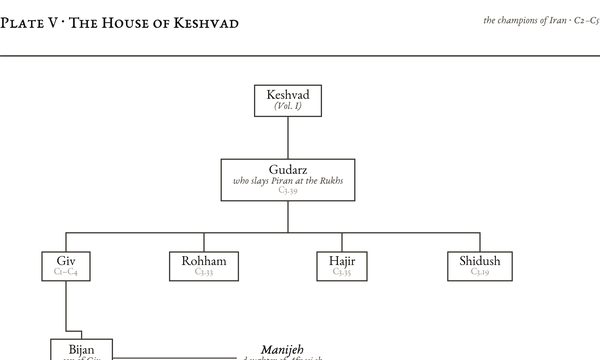 Plate VThe House of Keshvadthe champions of Iran · C2–C5
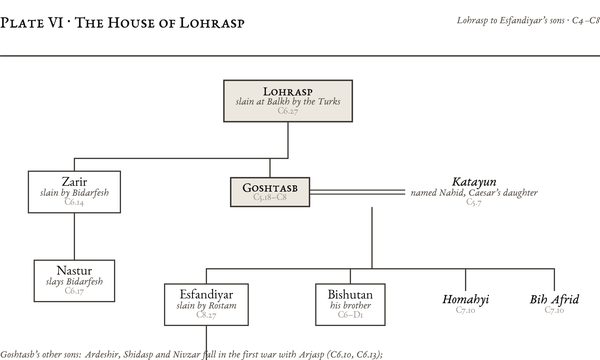 Plate VIThe House of LohraspLohrasp to Esfandiyar’s sons · C4–C8
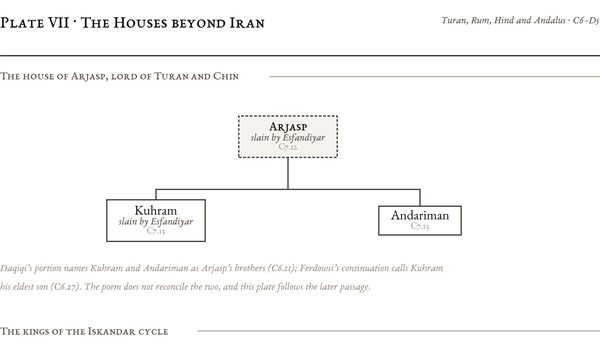 Plate VIIThe Houses beyond IranTuran, Rum, Hind and Andalus · C6–D5
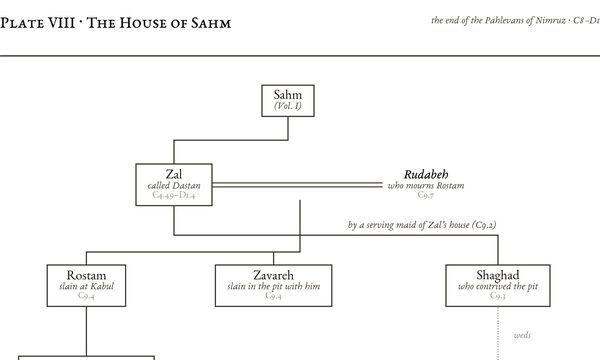 Plate VIIIThe House of Sahmthe end of the Pahlevans of Nimruz · C8–D1
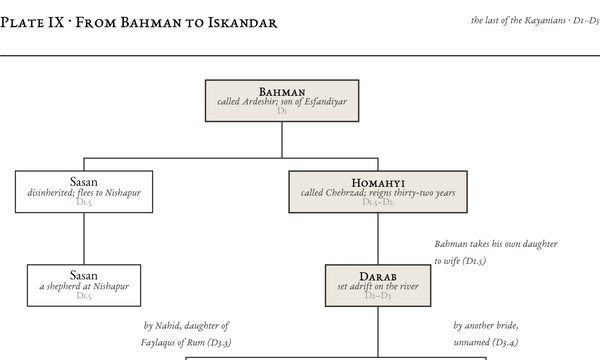 Plate IXFrom Bahman to Iskandarthe last of the Kayanians · D1–D5
Volume IIIBooks D5.40 to E11
Nine plates set out the house of Sasan through thirty-one reigns, from Ardeshir Babakan to the last Yazdegard. Plate I gives the whole succession at a glance; the eight that follow take it in stages, with the men and women around each throne — Ardavan and the Tribal Kings, Mehrak’s hidden daughter, Malika and the Roman wars, Monzer who reared Bahram Goor, Mazdak and Bozorgmehr, Bahram Chubin’s house, Maryam and Shirin, and the short reigns that end it.
This volume turns on names repeated down the line: six Bahrams reign, and four Hormizds, four Shapurs, three Ardeshirs and three Yazdegards. The plates identify each by the patronymic the poem gives him, and a table at the back, Kings of the Same Name, sets them side by side. Where the poem leaves a person unnamed — Babak’s daughter, Mehrak’s daughter, Anooshirvan’s Christian wife, the fifteen brothers of Shiruyeh — the plates say so rather than supply a name from elsewhere.
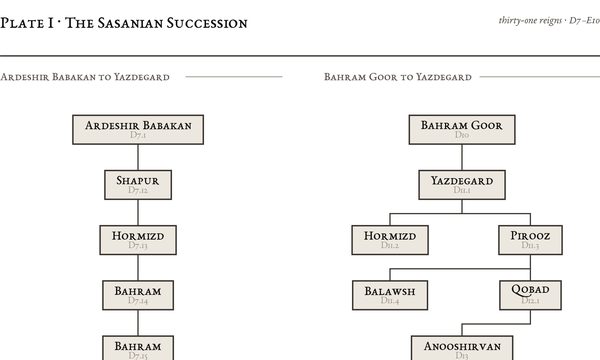 Plate IThe Sasanian Successionthirty-one reigns · D7–E10
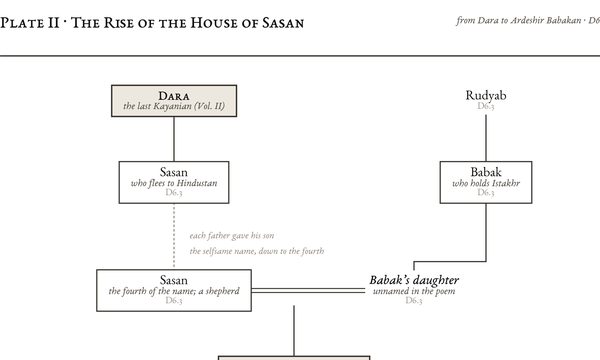 Plate IIThe Rise of the House of Sasanfrom Dara to Ardeshir Babakan · D6
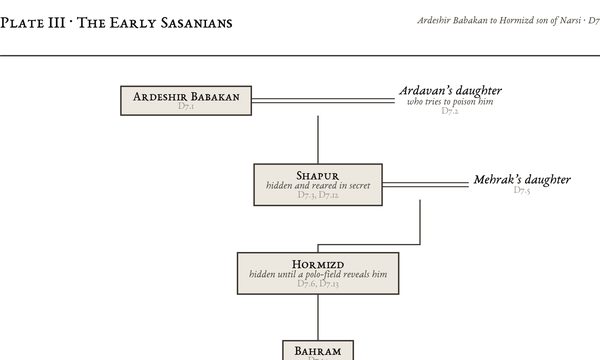 Plate IIIThe Early SasaniansArdeshir Babakan to Hormizd son of Narsi · D7
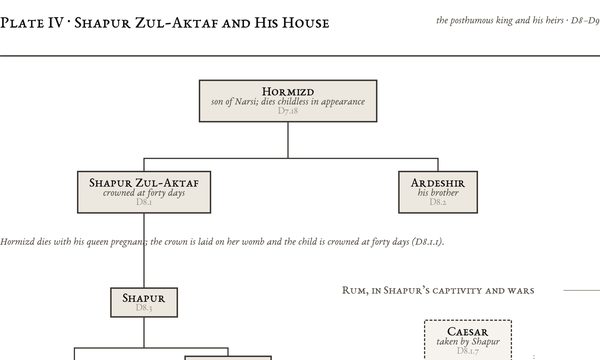 Plate IVShapur Zul-Aktaf and His Housethe posthumous king and his heirs · D8–D9
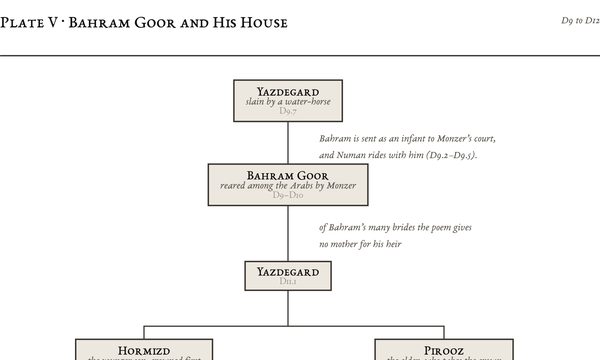 Plate VBahram Goor and His HouseD9 to D12
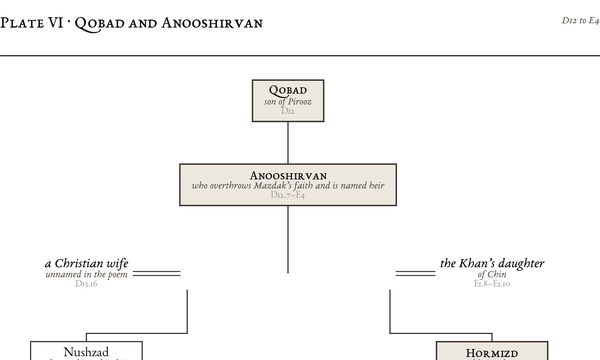 Plate VIQobad and AnooshirvanD12 to E4
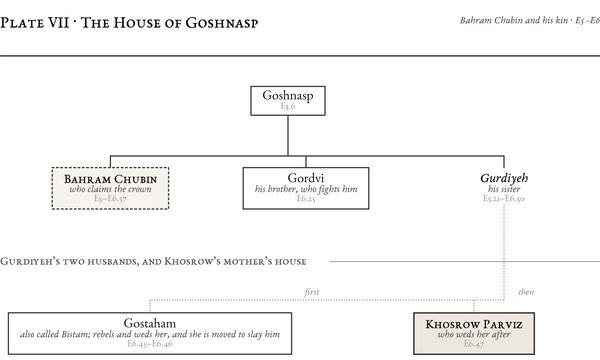 Plate VIIThe House of GoshnaspBahram Chubin and his kin · E5–E6
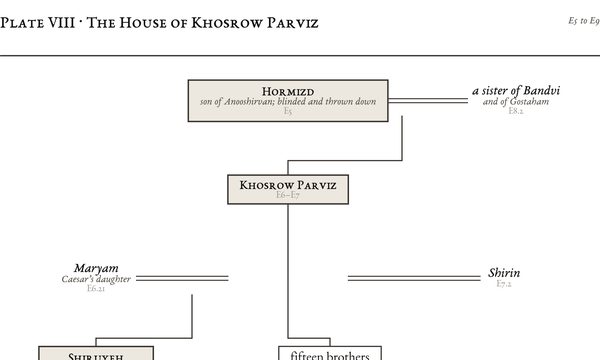 Plate VIIIThe House of Khosrow ParvizE5 to E9
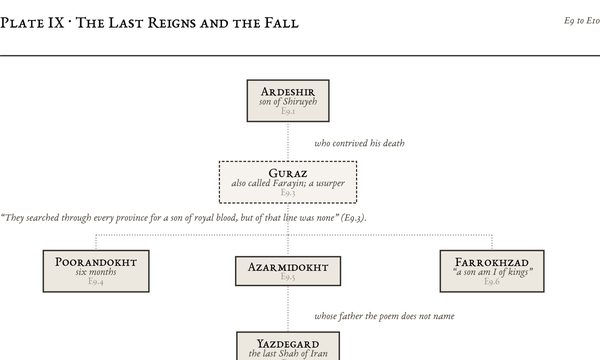 Plate IXThe Last Reigns and the FallE9 to E10
Kings of the same name
The poem gives many of these men the same name and distinguishes them only by a patronymic. Where two are set apart here, the distinction is the poem’s own.
| Ardeshir | Ardeshir Babakan, who founds the house (D7.1) · Ardeshir, brother of Shapur Zul-Aktaf (D8.2) · Ardeshir, son of Shiruyeh (E9.1). Bahman of Volume II is also called Ardeshir. |
|---|---|
| Bahram | Six of the line reign: son of Hormizd (D7.14) · son of Bahram (D7.15) · Bahram Bahramian, four months (D7.16) · son of Shapur (D8.4) · Bahram Goor (D10). Bahram the Ashkanian is called Ardavan the Great (D6.2). Bahram Chubin claims the crown but is of Goshnasp’s line, not the royal one (E5). |
| Hormizd | Son of Shapur (D7.13) · son of Narsi (D7.18) · son of Yazdegard (D11.2) · son of Anooshirvan (E5). Hormizd the Ashkanian is another (D6.2), and the last general Rostam is a further Hormizd’s son (E10.2). |
| Shapur | Son of Ardeshir Babakan (D7.12) · Shapur Zul-Aktaf, son of Hormizd (D8.1) · son of Shapur (D8.3). Shapur the Ashkanian is another (D6.2). |
| Yazdegard | Son of Shapur (D9.1) · son of Bahram Goor (D11.1) · the last Shah of Iran (E10). |
| Khosrow | Anooshirvan is called Kisra (D12.5) · Khosrow Parviz (E6). A third Khosrow, an aged man of noble race whose descent the poem does not give, is set on the throne between Yazdegard and Bahram Goor (D9.8). |
| Qobad | Qobad, son of Pirooz (D12.1). Qobad is also Shiruyeh’s private name, proclaimed when he takes the throne (E6.52, E7.11). |
| Narsi | Son of Bahram (D7.17) · Narsi the Ashkanian (D6.2). |
| Gostaham | One man, two names: his mother named him Bistam (E6.13). He is not the Gostaham of Volumes I and II. |
| Bijan, Gudarz, Arash | Ashkanian Tribal Kings (D6.2) bearing the names of the champions of Volumes I and II. A further Bijan, a commander of the Khan, brings Mahwi down (E10.13). |
| Rostam | The general who falls at Kadisiya (E10.2) is not Rostam son of Zal. |
Index of persons in the plates
255 entries. Each gives the volume, the chapter where the poem first gives the relation, and the plates on which the person stands.
| Name | Volume | First given | Plates |
|---|---|---|---|
| Abtin | I | A5.3 | II |
| Afrasiab | I | B1 | I, VI |
| Afrasiab | II | C1.5 | III |
| Aghriras | I | B1.13 | VI |
| Andariman (Arjasp) | II | C7.13 | VII |
| Andariman (Rukhs) | II | C3.37 | IV |
| Anooshirvan | III | D13 | I, VI |
| Arash (Ashkanian) | III | D6.2 | II |
| Ardavan | III | D6.2 | II, III |
| Ardavan’s daughter | III | D7.2 | III |
| Ardeshir Babakan | III | D7.1 | I, II, III |
| Ardeshir (Bijan) | II | C5.17 | V |
| Ardeshir (Goshtasb) | II | C6.10 | VI |
| Ardeshir (Shapur’s brother) | III | D8.2 | I, IV |
| Ardeshir (Shiruyeh’s son) | III | E9.1 | I, VIII, IX |
| Arezu | I | A6.6 | III |
| Arjasp | II | C6 | VII |
| Arnavaz | I | A5.7 | II |
| Ashk | III | D6.2 | II |
| Awkhast | II | C3.36 | IV |
| Azar Afruz | II | C6.23 | VI |
| Azarmidokht | III | E9.5 | I, IX |
| Babak | III | D6.3 | II |
| Babak’s daughter | III | D6.3 | II |
| Bahman | II | D1 | I, VI, VIII, IX |
| Bahram | I | B12.24 | VIII |
| Bahram (Ashkanian) | III | D6.2 | II |
| Bahram Bahramian | III | D7.16 | I, III |
| Bahram (Bahram’s son) | III | D7.15 | I, III |
| Bahram Chubin | III | E5.5 | VII |
| Bahram Goor | III | D10 | I, IV, V |
| Bahram (Hormizd’s son) | III | D7.14 | I, III |
| Bahram (Shapur’s son) | III | D8.4 | I, IV |
| Balawsh | III | D11.4 | I, V |
| Bandvi | III | E6.9 | VII |
| Banu Gashasp | I | B10.23 | VII |
| Baranush | III | D8.1.9 | IV |
| Barman | I | B1.8 | VI |
| Barman | II | C3.33 | IV |
| Bidarfesh | II | C6.14 | VI |
| Bih Afrid | II | C7.10 | VI |
| Bijan | I | B11 | VII, VIII |
| Bijan | II | C2 | III, IV, V |
| Bijan (against Mahwi) | III | E10.13 | IX |
| Bijan (Ashkanian) | III | D6.2 | II |
| Bishutan | II | C6 | VI, VIII |
| Bitlqun | II | D5.20 | VII |
| Borteh | II | C3.38 | IV |
| Bozorgmehr | III | D13.20 | VI |
| Caesar | III | D8.1.7 | IV |
| Dalaray | II | D5.2 | IX |
| Dara | II | D4 | I, IX |
| Dara | III | D6.3 | II |
| Darab | II | D2 | I, IX |
| Esfandiyar | II | C6.15 | I, VI |
| Faramarz | I | B10.5 | VII |
| Faramarz | II | C9.6 | VIII |
| Faranak | I | A5.4 | II |
| Farangis | I | B9.34 | V, VI |
| Farangis | II | Vol. I | II, III |
| Fariborz | I | B10.33 | V |
| Fariborz | II | C3.29 | II, IV |
| Farrokhzad | III | E9.6 | I, IX |
| Farshidvard (Goshtasb) | II | C6.31 | VI |
| Farshidvard (Viseh) | II | C3.45 | IV |
| Faryan | II | D5.19 | VII |
| Faylaqus | II | D3.3 | VII, IX |
| Fereydoon | I | A5 | I–III |
| Foor | II | D5.15 | VII |
| Forood | I | B12 | V, VI |
| Foruhil | II | C3.32 | IV |
| Garshasp, Pahlevan | I | A7.1 | VII |
| Garshasp, Shah | I | B2 | IV |
| Garsivaz | I | B9 | VI |
| Garsivaz | II | C4.44 | III |
| Gazhdaham | I | B8.8 | VIII |
| Gharan | I | A6.23 | VIII |
| Girami | II | C6.13 | VI |
| Giv | I | B4 | VII, VIII |
| Giv | II | C1.2 | IV, V |
| Golnar | III | D6.5 | II |
| Golshahr | I | B9.34 | VI |
| Golshahr | II | Vol. I | IV |
| Gordafarid | I | B8.9 | VIII |
| Gordvi | III | E6.25 | VII |
| Gorgin | I | B4.3 | VIII |
| Gorgin | II | C2.4 | IV, V |
| Goshnasp | III | E5.6 | VII |
| Goshtasb | II | C5.2 | I, VI |
| Gostaham | III | E6.45 | VII |
| Gostaham (Gazhdaham) | I | B8.8 | VIII |
| Gostaham (Nohzar) | I | B1.5 | IV |
| Gudarz | I | B11.5 | VIII |
| Gudarz | II | C3.39 | IV, V |
| Gudarz the Ashkanian | III | D6.2 | II |
| Guraz | III | E9.3 | I, IX |
| Guraza | II | C3.31 | IV |
| Gurazm | II | C6.22 | VI |
| Gurdiyeh | III | E5.21 | VII |
| Gurvi | II | C3.30 | IV |
| Hajir | I | B8.8 | VIII |
| Hajir | II | C3.35 | IV, V |
| Hohm | II | C4.41 | III |
| Homahyi (Bahman) | II | D1.5 | I, IX |
| Homahyi (Goshtasb) | II | C7.10 | VI |
| Hormizd (Anooshirvan’s son) | III | E5 | I, VI, VIII |
| Hormizd (Ashkanian) | III | D6.2 | II |
| Hormizd (Narsi’s son) | III | D7.18 | I, III, IV |
| Hormizd (Shapur’s son) | III | D7.13 | I, III |
| Hormizd (Yazdegard’s son) | III | D11.2 | I, V |
| Houman | I | B8.7 | VI |
| Houman | II | C3.15 | IV |
| Hushang | I | A2 | II |
| Iraj | I | A6 | I–III |
| Iskandar | II | D4 | I, IX |
| Jahan | II | C4.19 | III |
| Jamasp | II | C6.10 | VI |
| Jamasp | III | D12.3 | I, V |
| Jamshid | I | A4 | II |
| Jarireh | I | B9.34 | V, VI |
| Jarireh | II | Vol. I | IV |
| Katayun | II | C5.7 | VI |
| Kaveh | I | A5.5 | VIII |
| Kay Arash | I | B3.5 | V |
| Kay Armin | I | B3.5 | V |
| Kay Kavus | I | B4 | V |
| Kay Kavus | II | C4.46 | II |
| Kay Khosrow | I | B10 | V, VI |
| Kay Khosrow | II | C1 | I, II, III |
| Kay Pashin | I | B3.5 | V |
| Kay Qobad | I | B2.4 | IV, V |
| Kayd | II | D5.5 | VII |
| Kaydafa | II | D5.18 | VII |
| Keshvad | I | A6.15 | VIII |
| Keshvad | II | Vol. I | V |
| Khoshnavaz | III | D11.3 | V |
| Khosrow Parviz | III | E6 | I, VII, VIII |
| Kioumars | I | A1 | II |
| Kuhram (Arjasp) | II | C6.27 | VII |
| Kuhram (Rukhs) | II | C3.38 | IV |
| Kulbad | II | C3.29 | IV |
| Lahhak | II | C3.45 | IV |
| Lohrasp | II | C4.60 | I, II, VI |
| Mah-Afarid | I | A6.14 | III |
| Mahbud | III | E1.1 | VI |
| Mah-e Azadeh | I | A6.6 | III |
| Mahwi Suri | III | E10.11 | IX |
| Malika | III | D8.1.2 | IV |
| Mani | III | D8.1.11 | IV |
| Manijeh | II | C2 | III, V |
| Manuchehr | I | A6.15 | III, IV |
| Mardas | I | A4.2 | II |
| Maryam | III | E6.21 | VIII |
| Mazdak | III | D12.6 | V |
| Mehr Ormozd | III | E8.5 | VIII |
| Mehrab | I | A8.1 | VII |
| Mehrak | III | D6.14 | III |
| Mehrak’s daughter | III | D7.5 | III |
| Mehr-e-Nush | II | C8.22 | VI |
| Milad | I | B4.3 | VIII |
| Milad | II | Vol. I | V |
| Monzer | III | D9.2 | V |
| Nahid (of Rum) | II | D3.3 | VII, IX |
| Nariman | I | A9.3 | VII |
| Narsi (Ashkanian) | III | D6.2 | II |
| Narsi (Bahram’s son) | III | D7.17 | I, III |
| Nastur | II | C6.17 | VI |
| Nivzar | II | C6.10 | VI |
| Nohzar | I | B1 | IV |
| Numan | III | D9.2 | V |
| Nush Azar | II | C8.22 | VI |
| Nushzad | III | D13.16 | VI |
| Pashang | II | Vol. I | III |
| Pashang of Iran | I | A6.14 | III |
| Pashang of Turan | I | B1.2 | III, VI |
| Pilsam | I | B10.8 | VI |
| Piran | I | B9 | VI |
| Piran | II | C2.9 | IV |
| Pirooz | III | D11.3 | I, V |
| Poorandokht | III | E9.4 | I, IX |
| Qarakhan | II | C4.2 | III |
| Qaydrush | II | D5.19 | VII |
| Qobad | I | B1.4 | VIII |
| Qobad (Pirooz’s son) | III | D12.1 | I, V, VI |
| Rivniz | I | B12.7 | IV |
| Rohham | I | B5.10 | VIII |
| Rohham | II | C3.33 | IV, V |
| Roshanak | II | D4.9 | IX |
| Rostam | I | A9 | VII |
| Rostam | II | C1 | VIII |
| Rostam (Hormizd’s son) | III | E10.2 | IX |
| Rudabeh | I | A8 | VII |
| Rudabeh | II | C9.7 | VIII |
| Rudyab | III | D6.3 | II |
| Ruyin | II | C3.34 | IV |
| Sa’ad | III | E10.2 | IX |
| Sahi | I | A6.6 | III |
| Sahm | I | A7 | VII |
| Sahm | II | Vol. I | VIII |
| Salm | I | A6 | I–III |
| Sasan | III | D6.3 | II |
| Sasan the elder | II | D1.5 | IX |
| Sasan the younger | II | D1.5 | IX |
| Shaghad | II | C9.2 | VIII |
| Shahr-Banu | I | B10.23 | VII |
| Shahrnaz | I | A5.7 | II |
| Shapur (Ardeshir’s son) | III | D7.12 | I, III |
| Shapur (Ashkanian) | III | D6.2 | II |
| Shapur (Shapur’s son) | III | D8.3 | I, IV |
| Shapur Zul-Aktaf | III | D8.1 | I, IV |
| Shavaran | II | C3.36 | IV, V |
| Shidasp | II | C6.10 | VI |
| Shideh | I | B14.21 | VI |
| Shideh | II | C4.9 | III |
| Shidush | I | B13.9 | VIII |
| Shidush | II | C3.19 | V |
| Shirin | III | E7.2 | VIII |
| Shiruya | II | C5.17 | V |
| Shiruyeh | III | E6.52 | I, VIII |
| Siamak | I | A1.2 | II |
| Siamak | II | C3.31 | IV |
| Siavash | I | B9 | V |
| Siavash | II | Vol. I | II |
| Sindokht | I | A8.2 | VII |
| Sipahram | II | C3.35 | IV |
| Sofrye | III | D11.4 | V |
| Sohrab | I | B8 | VII |
| Sudabeh | I | B6.2 | V |
| Surkha | I | B10.6 | VI |
| Tahmasp | I | B1.14 | IV |
| Tahmineh | I | B8.4 | VII |
| Tahmuras | I | A3 | II |
| Tair | III | D8.1.2 | IV |
| Taynush | II | D5.22 | VII |
| Tur | I | A6 | I–III |
| Viseh | I | B1.8 | VI |
| Viseh | II | Vol. I | IV |
| Yalan-sina | III | E5.6 | VII |
| Yanus | III | D8.1.8 | IV |
| Yazdegard (Bahram Goor’s son) | III | D11.1 | I, V |
| Yazdegard (Shapur’s son) | III | D9.1 | I, IV, V |
| Yazdegard (the last) | III | E10 | I, IX |
| Zadeshm | I | B1.2 | III, VI |
| Zahhak | I | A4 | II, VII |
| Zal | I | A7.2 | VII |
| Zal | II | C4.49 | VIII |
| Zangeh | II | C3.36 | IV, V |
| Zangula | II | C3.32 | IV |
| Zarasp | I | B12.8 | IV |
| Zarir | II | C5.2 | VI |
| Zarvan | III | E1.1 | VI |
| Zav | I | B1.14 | IV |
| Zavareh | I | B7 | VII |
| Zavareh | II | C9.4 | VIII |
| Zhendeh Razm | I | B8.15 | VII |