 New Naqqali
Zalزال
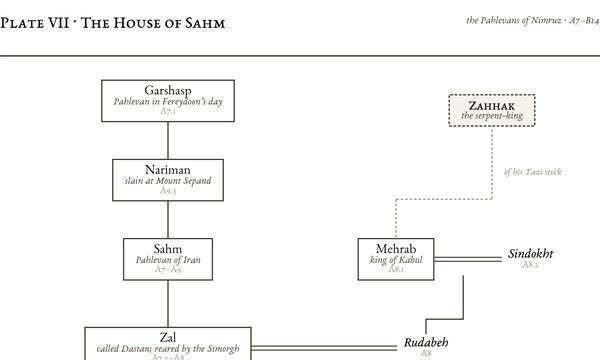
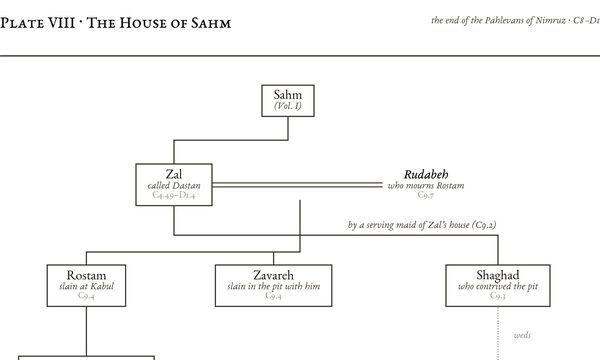
Son of Sahm, born white-haired, raised by the Simorgh; also called Dastan and Zal-e-Zar. Father of Rostam; outlives him and is put in chains by Bahman.
- His story
- From A7.2, The Strange Birth of Zal, to D1.4, Bahman Releases Zal
- Named
- 505 times under his three names (Zal, Dastan, Zal-e-Zar), in 149 dastans
- Parents
- Sahm
- Spouses
- Rudabeh
- Children
- Rostam, Zavareh, Shaghad
- Plates
- Vol I: VII, Vol II: VIII
His story, in the poem’s own sections
The Strange Birth of Zal
Sahm’s wife bears a beautiful son whose hair is snow-white. Ashamed, and fearing the child is the offspring of a Div, Sahm has him left on Mount Alborz. The Simorgh swoops down to take him for her chicks, but pity moves her and she raises him.
Sahm Gives the Kingdom to Zal
Ordered to campaign against Mazandaran and the Gorgasaran, Sahm entrusts Zal to his elders and gives him Zabul. Zal begs to go with him but is sent back. He takes the throne and studies with sages until his wisdom and beauty are famous.
Zal and Rudabeh: A Secret Visit
At dusk Rudabeh appears on the palace roof and lets down her hair for Zal to climb. He kisses it but will not hurt her, and climbs by his own kamand. They feast, embrace and swear to marry, and part in tears at dawn.
Zal Answers the Mobadan
Zal solves each riddle: the months and their days, day and night, the nights of the lunar month, the two halves of the year with the sun between them, this passing world and the lasting one beyond, and Time the reaper, who spares no one.
Zal Returns to Kabul, Sahm and Rudabeh
Zal returns to Sahm, who tells him of his pact with Sindokht. Father and son ride to Kabul, where Mehrab welcomes them. Zal and Rudabeh marry amid weeks of feasting. Afterwards Sahm gives Zal the rule of Sistan and marches against the Gorgasaran.
Zal Counsels Kay Kavus
Zal warns Kay Kavus that no earlier king ever marched on Mazandaran, land of Divs and sorcery. Kavus, claiming to surpass Jamshid and Fereydoon, dismisses him and leaves Zal and Rostam to guard Iran. Zal submits, and Giv and the chiefs escort him on his way.
Zal Reproaches Khosrow
Zal reproaches the Shah openly: he was bred in Turan, and one grandfather was a sorcerer and the other a fool who ignored the same advice and fell out of the sky. To leave the throne now is Div-counsel, and the farr will be stripped from him. The chiefs agree.
The Simorgh Comes to Rostam’s Aid
Zal burns the Simorgh’s feather. The bird draws out the arrowheads and heals Rostam and Rakhsh, warns that Esfandiyar’s killer is doomed in both worlds, then leads Rostam to a tamarisk beside the sea and teaches him to make the fatal arrow.
Zal Hears of Rostam’s Death
One rider carries the news to Zabul, where Zal mourns Rostam, Zavareh and Rakhsh. Faramarz finds Kabul deserted, has the bodies washed, perfumed and coffined, and brings them home, where Rostam is laid on golden thrones in a garden tomb.
Bahman Humiliates Zal
Bahman halts on the Hirmund and sends Zal a threat. Zal pleads Rostam’s long service and offers all his treasure. Bahman comes, hears him out, then has his feet bound, loads the wealth of Sistan onto camels, and gives Zabul over to plunder.
Family
- Parents
- Sahm
- Spouses
- Rudabeh
- Children
- Rostam, Zavareh, Shaghad
Where he appears
A7The First Kings: Manuchehr19A8The Story of Zal and Rudabeh131A9The Birth and Early Feats of Rostam; Manuchehr’s Closing Counsel36B1The Crisis after Manuchehr41B2Garshasp and the Transition to Kayanian Kingship20B3Kay Qobad17B4The War with Mazandaran27B5The Seven Labors of Rostam7B6The Folly of Kay Kavus1B8The Tragedy of Rostam & Sohrab17B9The Story of Siavash9B10Vengeance for Siavash and the Retrieval of Kay Khosrow4B11Kay Khosrow’s Kingship7B13Mount Hamavan and the Kamus Campaign7B14The Great Battle with the Khan of Chin6C1Rostam and the Div Akvan4C2The Tale of Bijan and Manijeh15C3The Battle of the Twelve Rukhs1C4The Final Afrasiab Wars and the Disappearance of Kay Khosrow43C5Lohrasp1C6Goshtasb, Zardosht, and the War with Arjasp3C8The Tragedy of Rostam and Esfandiyar57C9Rostam and Shaghad16D1The Reign of Bahman, Son of Esfandiyar16E8Shiruyeh’s Coup and the End of the Great Reign1